


Resilience is on everyone’s agenda. Yet, as expectations grow and disciplines become increasingly interconnected, building a truly resilient organization is more complex than ever.
Building a resilient organization sounds like a straightforward ambition. After all, which organization would not want to withstand disruption, adapt to change, and continue delivering their products and services?
In practice, however, achieving organizational resilience is far from straightforward. While Business Continuity and Crisis Management are manifested disciplines supporting the overall organizational resilience program in any organization, the resilience field has evolved into a much broader landscape of interconnected disciplines, regulatory requirements, operational dependencies, and stakeholder expectations.
Organizations are increasingly expected to demonstrate resilience across their operations, IT, OT, supply chains and people. Yet these responsibilities often sit within different functions, follow different frameworks, and compete for the same resources.
The question is no longer simply whether an organization has resilient arrangements in place, but whether those arrangements collectively provide the capability needed to respond, adapt and recover when it matters most.
1. Organizational Resilience Is Not Just One Discipline
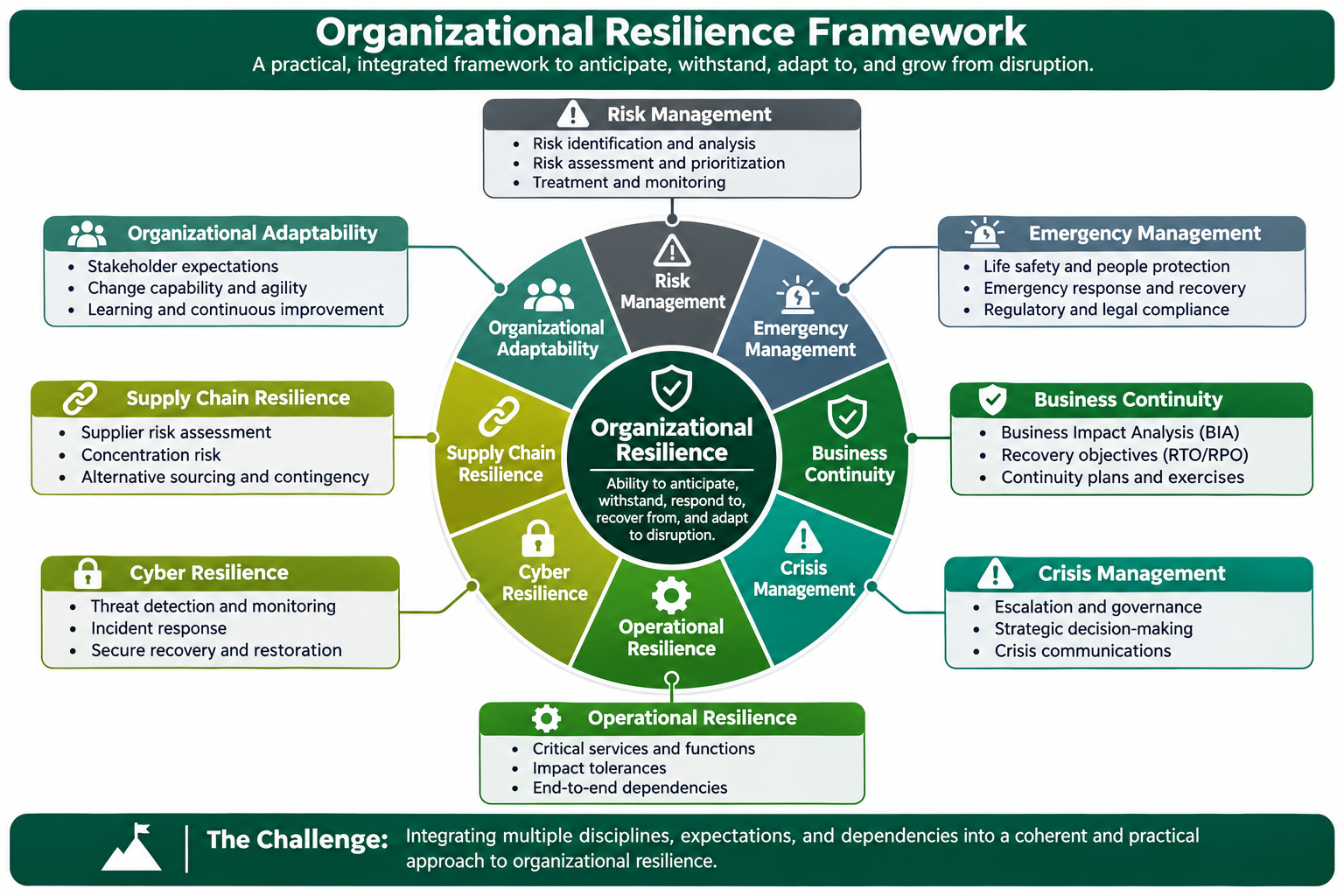
Organizational Resilience is a broad concept, supported by several disciplines that have – perhaps in isolation – developed their own methodologies, frameworks, standards, and professional communities over time.
Business Continuity focuses on an organization’s ability to continue delivering prioritized products and services at acceptable predefined levels following disruption. إدارة الأزمات addresses the strategic leadership and decision-making required during significant disruptive events. Operational Resilience promotes the proactive capability to anticipate, mitigate, respond to and recover from disruption to operational activities.
Alongside these, cyber resilience, supply chain resilience, risk management, emergency response/ management, and organizational adaptability all contribute to an organization’s overall resilience architecture.
Each discipline has a legitimate purpose and brings specific expertise. However, their boundaries are not always clearly defined, and there are considerable overlaps in objectives, activities, and responsibilities.
For organizations, this raises important questions:
- How do these disciplines relate to one another?
- Where do their responsibilities overlap, and where should they remain distinct?
- How can existing capabilities be leveraged without duplicating effort?
- Who is responsible for coordinating resilience across the organization?
The challenge is not necessarily to combine all these disciplines into a single function, but to ensure they complement one another and contribute to common organizational objectives.
2. Expanding Expectations and Requirements
The expectations placed on organizations continue to grow. Regulators, customers, investors, business partners, and other stakeholders increasingly expect organizations to demonstrate that they can manage disruption and maintain critical operations. International standards, industry-specific regulations, contractual obligations, and internal governance requirements add further layers of expectations.
While these requirements often share common objectives, they may differ in terminology, scope, methodologies, reporting obligations, and levels of assurance. An organization may therefore find itself implementing several resilience-related initiatives simultaneously, each driven by a different requirement or stakeholder. The result can be a growing collection of policies, frameworks, assessments, plans, and reporting mechanisms.
More resilience-related activities, however, do not automatically translate into greater organizational resilience.
Organizations need to understand which requirements are applicable, how they relate to existing capabilities, and where integration can enhance capabilities or reduce duplication without compromising specific obligations.
3. Organizational Silos and Fragmented Ownership
Resilience cannot be achieved by a single department.
Business Continuity, Crisis Management, Information Security, IT Disaster Recovery, OT Security, Risk Management, Human Resources, Procurement, Facilities Management, and Operations – all play important roles. However, these functions frequently operate within their own governance structures, budgets, priorities, and reporting lines. To avoid fragmented and isolated approaches, individual business units/departments need to fully understand their dependencies on other functions. E.g. an organization’s Business Continuity Plan that may assume that critical IT services will be recovered within a defined timeframe, while the IT recovery arrangements are based on different priorities or assumptions. Similarly, supply chain dependencies may be identified during a Business Impact Analysis but not adequately reflected in procurement risk assessments, specified business requirements or supplier chain management arrangements.
These disconnects are not always visible during routine operations. They often become apparent only when an actual disruption occurs or when arrangements are tested through realistic exercises.
Effective resilience therefore requires more than individual departmental capabilities. It requires coordination, shared understanding, clearly defined responsibilities, and alignment across organizational boundaries.
4. Balancing Resilience Ambitions with Business Reality
Organizations that have limited resources to invest in resilience management must balance resilience requirements against operational efficiency, financial performance, growth objectives, technological transformation, and other strategic priorities.
While it may be desirable to eliminate every vulnerability, prevent every disruption, and recover every activity immediately, this is neither realistic nor economically sustainable. Building resilience involves making informed decisions about what matters most, which disruptions the organization must be prepared for, and what levels of impact and interruption are acceptable. Cost benefit analysis techniques as part of BCM design strategies and solutions are one approach to this within a BCMS.
This requires an understanding of prioritized products or services, supporting activities, dependencies, vulnerabilities, and the potential consequences of disruption. It also requires leadership to make decisions about investment, risk acceptance, recovery priorities, and the level of resilience the organization aims to achieve.
The objective should not be maximum resilience at any cost, but an appropriate and proportionate level of resilience aligned with the organization’s objectives, obligations, and risk appetite.
5. The Human Factor: Capabilities, Culture, and Leadership
Frameworks, plans, processes, and technology are important foundations, but they do not create resilience on their own. Ultimately, organizations depend on people to recognize emerging threats, make decisions, coordinate responses, adapt to changing circumstances, and manage disruption. This requires clearly defined roles and responsibilities, competent personnel, effective communication, and leadership that understands its role before, during, and after disruptive events.
One of the challenges organizations face is that resilience responsibilities are often assigned to individuals whose primary roles lie elsewhere.
A department manager may be responsible for maintaining a Business Continuity Plan, participating in a Crisis Management Team, supporting exercises, and implementing corrective actions, alongside their day-to-day operational responsibilities. Without adequate training, guidance, management support, and practical experience, these responsibilities can become administrative obligations rather than meaningful capabilities. Regular training, exercises, and lessons learned from actual incidents help build confidence, strengthen collaboration, and develop the practical skills needed when established procedures are no longer sufficient.
Resilience must be embedded into organizational culture and everyday decision-making.
6. Resilience Is a Continuous Journey
Perhaps one of the biggest challenges is that resilience can never be considered permanently complete. Organizations must continuously evolve and improve. Business models change, new technologies are introduced, supply chains are restructured, employees move into different roles, and new products and services are developed. At the same time, external threats, regulatory expectations, and stakeholder requirements continue to change continuously.
A resilience arrangement that was appropriate two years ago may no longer reflect the organization’s current operating environment.
This makes regular review, validation, exercising, and continual improvement essential. However, maintaining resilience capabilities requires sustained management attention and resources, particularly when the organization has not recently experienced a significant disruption. There is also a risk that resilience programs become focused on demonstrating compliance through completed documentation, rather than evaluating whether the organization can actually perform under pressure.
The existence of a plan is not evidence that an organization can successfully execute it.
Exercises, simulations, scenario-based discussions, and reviews of actual incidents provide opportunities to challenge assumptions, identify gaps, and improve the organization’s ability to respond and recover.
Conclusion
Managing Complexity Without Creating More Complexity
With so many disciplines, requirements, and stakeholders involved, organizations may be tempted to introduce additional frameworks, governance structures, and reporting mechanisms to bring everything together. While coordination is essential, adding more layers of processes and oversight does not necessarily solve the underlying challenges.
A more practical approach:
- Begins with understanding the organization’s objectives, its prioritized products and services, and the capabilities already in place.
- Rather than building entirely new structures, organizations should consider how existing disciplines and incident response structures can work together more effectively.
- Establishing clear accountability, aligning priorities, identifying common dependencies, sharing relevant information, and coordinating resilience activities wherever practical.
- Recognizing that different disciplines may need to retain their own specialist approaches while contributing to a broader organizational resilience objective.
The aim should be to achieve greater consistency, visibility, and effectiveness without introducing unnecessary bureaucracy.
Building a resilient organization is complex because organizations themselves are complex. They operate through interconnected processes, people, technologies, suppliers, and external relationships, all of which are subject to continuous change.
No single framework, standard, department, or professional discipline can address every aspect of organizational resilience. Business Continuity, Crisis Management, Operational Resilience, Cyber Resilience, and other related disciplines each make important contributions. Their effectiveness, however, depends not only on their individual maturity but also on how well they work together.
Organizations should therefore look beyond the implementation of individual resilience programs and consider how these collectively support their ability to anticipate, prepare for, respond to, recover from, and adapt to disruption.
The objective is not to make resilience more complex, but to manage its complexity through clear priorities, coordinated capabilities, and a practical understanding of what truly matters to the organization.
At Marjason Consulting, we support organizations in strengthening their Business Continuity, Crisis Management, and broader resilience capabilities through practical consultancy, professional training, workshops and validation exercises. Get in touch.